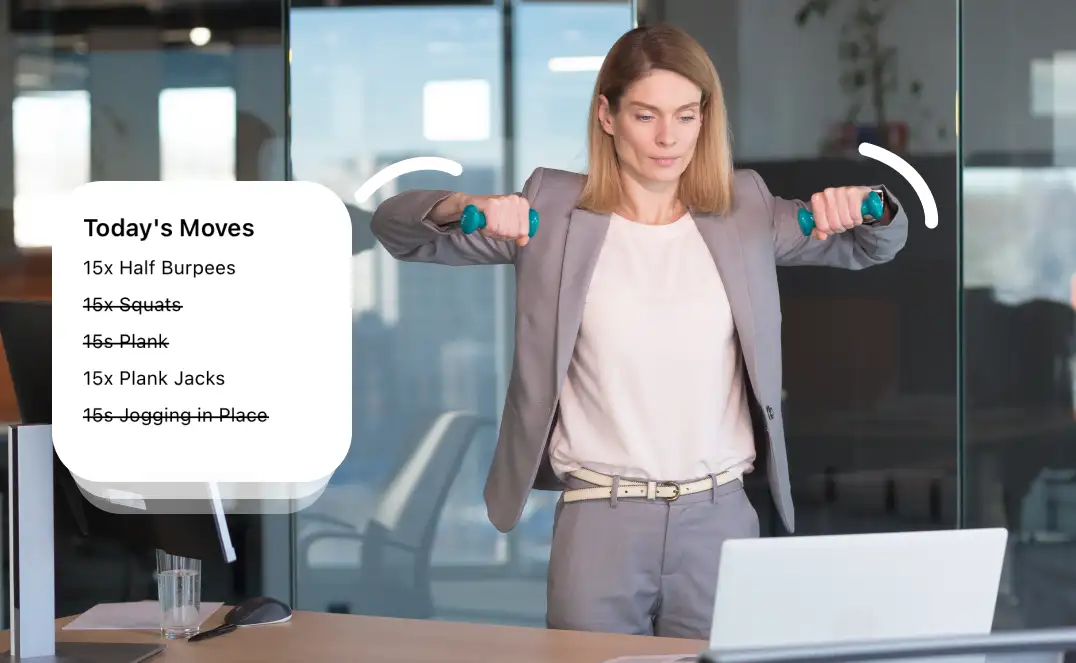
woman doing exercise snack

What is an exercise snack?

An exercise snack is a very short bout of physical activity, usually 20 seconds to 5 minutes, done on its own, several times a day, instead of being packed into one long workout. Ten squats while the kettle boils. One flight of stairs taken quickly. A brisk two-minute walk after lunch. Each one is small enough to skip a change of clothes and a shower, and that is precisely the point.
woman doing exercise snack

The name is borrowed from eating: if a workout is a meal, these are the snacks in between. Researchers have used the term since the mid-2000s, and it was popularised by exercise physiology labs studying how much benefit you can squeeze out of very brief, fairly hard efforts. A closely related term you will see in the research is VILPA, vigorous intermittent lifestyle physical activity, which describes the same idea using everyday movement rather than deliberate training.

This guide covers the science, the rules for building your own, a library of 30+ snacks sorted by where you are, sample daily schedules, and the mistakes that make people quit.

Why something so short works

The intuition that only long sessions count comes from an era when exercise research mostly studied long sessions. Once labs started measuring short, hard efforts on their own, four separate mechanisms showed up.

Intensity substitutes for time

A hard 20-second effort reaches your heart and lungs in a way a gentle half-hour stroll never does.

Your legs are a glucose sink

Contracting muscle pulls sugar from the blood without needing insulin, which is why post-meal walks work so well.

Sitting itself is the problem

Long unbroken sitting isn't fully undone by one evening session. Snacks break it up where it happens.

The dose you actually do

No gym bag, no commute, no free hour, so it survives the exact weeks that end most training plans.

The Evidence

Research on Exercise Snacks

Every claim on this page traces back to one of these. Each links to the study itself.

Stair snacks raised fitness in six weeks
Jenkins et al. · Appl Physiol Nutr Metab · 2019

Sedentary adults climbed a 60-step stairwell three times a day, three days a week. Peak oxygen uptake rose against a control group, though the authors called the absolute gain modest.

Read the study
Three to four minutes a day, tracked on the wrist
Stamatakis et al. · Nature Medicine · 2022

Wearables on roughly 25,000 UK Biobank non-exercisers captured brief bursts of hard daily movement. Very small daily amounts tracked with markedly lower mortality. Observational, so association rather than proof of cause.

Read the study
Five minutes of walking every half hour
Duran et al. · Med Sci Sports Exerc · 2023

Five different walking-break patterns were tested across eight hours of sitting. Only five minutes every thirty minutes lowered both blood sugar and blood pressure. Hourly breaks did nothing for glucose.

Read the study
Twice daily at home, for four weeks
Perkin et al. · Journal of Aging Research · 2019

Twenty healthy older adults did brief unsupervised bodyweight snacks twice a day for 28 days. Their one-minute sit-to-stand score improved sharply while the control group did not change.

Read the study
Snacks measured against a normal workout
Yin et al. · Appl Physiol Nutr Metab · 2024

Inactive adults were split between stair-climbing snacks, moderate continuous training, and nothing. Over six weeks the snacks improved fitness comparably to the longer sessions, in a fraction of the time.

Read the study
Why brief bursts affect metabolism
Islam, Gibala & Little · Exerc Sport Sci Rev · 2022

A review from the labs that coined much of this work, setting out the mechanisms behind exercise snacks and where they fit in cardiometabolic health.

Read the review
What the evidence most supports

Ranked by how well established each finding currently is.

  • Cardiorespiratory fitness. The most replicated result. Multiple controlled trials show short, hard bouts raise peak oxygen uptake in inactive people, with at least one finding it comparable to far longer sessions.
  • Post-meal blood sugar. Consistent and immediate. Breaking up sitting with brief walking measurably blunts glucose spikes, with frequency mattering more than total time.
  • Everyday leg function in older adults. Promising. Sit-to-stand and similar measures improve within weeks, from pilot studies with small groups.
  • Actually doing it. Adherence in these trials runs high, which is the whole argument: a smaller dose you complete beats a larger one you skip.
  • Living longer. The largest effect reported, but from observational data. Encouraging rather than established.
Are Exercise Snacks better than a Gym Workout?

Two recent reviews surveying the whole field reach the same conclusion: the fitness gains are real but modest, and effects on other outcomes remain unclear. Exercise Snacks will not replace Gym workouts, but are definitely much better than not moving!

The Recipe

How to Do Exercise Snacks

Three dials. Get these roughly right and the details matter far less than starting.

How long
20s – 5 min

Hard efforts stay short. Easy movement can stretch longer. If it needs a shower, it's not a snack.

How hard
6–8 / 10

Breathing hard, short sentences only. Stop a couple of reps before failure, no grinding.

How often
3–5 a day

Spread across the day, an hour or more apart. Frequency beats one heroic session.

The 60-second starter snack

If you want to stop reading and start now, do this once today:

  • 15x bodyweight squats, controlled on the way down
  • 20 seconds marching or jogging on the spot, fast
  • 10x slow calf raises, pausing at the top
  • 15 seconds standing quad or hamstring stretch, each side
30+ Ideas

The Exercise Snack library

Sorted by where you are, because that is what actually decides whether a snack happens.

At your desk

Chair stands

Stand up and sit down 15 times without using your hands. 45 seconds.

Desk push-ups

Hands on a sturdy desk edge, body straight, 12–20 reps. 40 seconds.

Seated calf raises

Heels up and down, continuously, while you read. 2 minutes.

Wall sit

Back flat to the wall, thighs parallel, hold. 30–45 seconds.

Doorway chest stretch

Forearms on the frame, step through, breathe. 30 seconds a side.

Neck and shoulder resets

Slow shoulder rolls, chin tucks, ear-to-shoulder holds. 1 minute.

Get your heart rate up

Stair sprint

One flight, as fast as is safe, hand near the rail. 20–30 seconds.

Jumping jacks

Fast and rhythmic until breathing gets heavy. 40 seconds.

High knees

On the spot, knees to hip height, quick feet. 30 seconds.

Squat pulses

Hold a half squat and pulse fast, no rest. 30 seconds.

Burpees, no jump

Step back, step in, stand tall. 8–10 reps. 45 seconds.

Brisk lap

Round the building or the block, walking hard. 3 minutes.

Build strength

Split squats

8–10 slow reps each leg, back knee toward the floor. 60 seconds.

Push-ups

Floor, knees or an elevated surface, whichever lets you do 8 clean reps.

Hip hinges

Hands on hips, push the hips back, flat back, 12 reps. 45 seconds.

Glute bridges

On the floor, squeeze hard at the top, 15 reps. 45 seconds.

Single-leg calf raises

12 per side off a step, slow lower. 60 seconds.

Dead hang or row

Hang from a bar, or row under a table edge. 30 seconds.

After a meal

The two-minute walk

Easy pace, starting within an hour of eating. The most studied snack there is.

Standing calf pumps

Continuous, unhurried heel raises while the dishes soak. 2–3 minutes.

Ten-rep squats

Slow and easy, not hard enough to feel uncomfortable on a full stomach.

Hotels, airports and small spaces

Luggage carries

Carry the bag rather than wheel it, one side then the other. 60 seconds.

Escalator, walked

Take the stairs instead, or walk up the moving one. Free intensity.

Bed-edge step-ups

Use a sturdy chair or low step, 10 per leg, quick tempo. 60 seconds.

Isometric wall push

Push hard into a wall for 10 seconds, five times. Silent, no space needed.

Gate walk

One brisk lap of the terminal before boarding. 3–5 minutes.

Hip openers

Deep squat hold and standing hip circles after a long flight. 90 seconds.

Exercise Snacks vs. full workouts

This is not a replacement for training if you already train, it is what fills the days you do not. Here is where each one wins.

What you want Exercise snacks Longer sessions
Everyday health markers Strong, spread-out movement suits blood sugar and sitting Strong, but one block leaves the rest of the day sedentary
Base cardio fitness Good, if some snacks are genuinely hard Better, especially for endurance
Visible muscle growth Modest, helpful if you currently do nothing Better, with progressive loading
Sticking with it Excellent, no barrier to entry Harder to protect when life gets busy
Training for an event Supplementary only Necessary

If you train three times a week already, snacks make your off days less sedentary. If you currently train zero times a week, snacks are the highest-return change available to you, and often the on-ramp to something longer.

Put It Together

Three sample days

Each of these adds up to under ten minutes of movement, tucked into gaps that already exist.

The office day
  • 08:40 Stairs instead of the lift, taken quickly
  • 10:30 15 chair stands between meetings
  • 13:15 Two-minute walk after lunch
  • 15:00 40 seconds of desk push-ups and shoulder rolls
  • 17:30 Stairs down, one extra flight up first
Working from home
  • Kettle on 15 squats while it boils
  • 11:00 30 seconds of high knees between calls
  • After lunch Lap of the block
  • Mid-afternoon Split squats, 8 each side
  • Before dinner Glute bridges and hip openers
On the road
  • Airport Walk the terminal, carry the bag
  • Hotel arrival 10 step-ups per leg on the chair
  • Before a meeting Isometric wall pushes, 5 × 10 seconds
  • After dinner Two-minute walk outside
  • Room, evening Deep squat hold and stretches
Make it a Habit

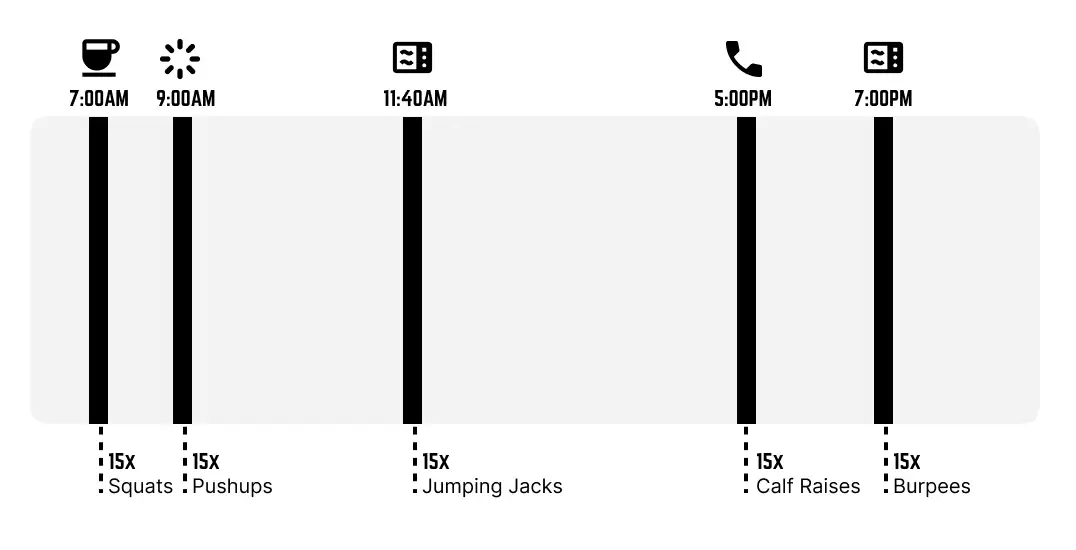
Attach each Exercise Snack to something you already do

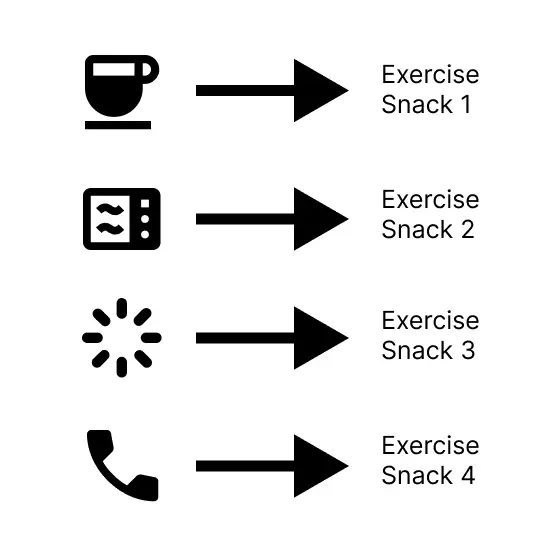
Exercise fails for one reason: nothing reminds you. Motivation is not the missing piece, a trigger is. Tie each exercise snack to an event that already happens on its own, every day, without your input.

Exercise snack habit

Five mistakes that end the habit

1. Starting with eight a day

Three is a habit. Eight is a project. Add more only once three feels automatic.

2. Going too easy every time

If nothing ever feels hard, fitness will not move. At least one snack a day should leave you breathing.

3. Going too hard, cold

Sprinting up stairs from a chair after four hours of sitting is how calves and Achilles get hurt. Ten seconds of easy movement first.

4. Choosing snacks that need setup

Anything requiring shoes, equipment or a different room will quietly stop happening by week two.

5. Treating a missed day as failure

Miss one, resume the next. The only version of this that fails completely is the one you abandon.

A word on safety

Ease into intensity, use a handrail on stairs, and stop if you feel chest pain, dizziness or unusual breathlessness. If you have a heart condition, are pregnant, are managing an injury, or have been inactive for a long time, check with a doctor before adding vigorous bursts.

Exercise Snacks on Auto

Let ShortReps Pick 5 Exercises Daily

Reading a list of exercises is one thing, remembering to do them is another. ShortReps turns everything on this page into a daily habit that runs itself.

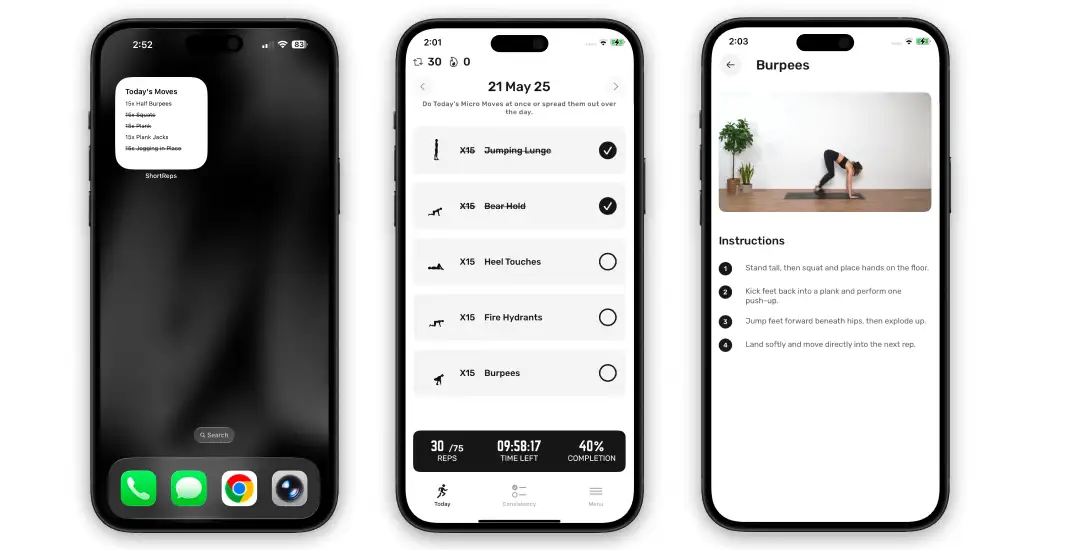
ShortReps app showing a home screen widget, 5 daily exercise snacks, and posture video instructions
A home screen widget

Shows today's exercise snacks at a glance, no need to open the app to remember what's next.

5 exercises picked for you daily

Matched to your fitness level so you never have to plan an exercise snack yourself.

Video posture instructions

So hard efforts stay safe instead of turning into an injury.

Exercise snacking FAQs

  • Yes. Major physical activity guidelines dropped the old ten-minute minimum years ago, every minute of movement counts toward your weekly total. Short bouts are measured differently in research, but they are exercise.

  • Start with three on most days and build toward five. Spacing matters more than the count, snacks scattered across the day break up sitting, which is much of the benefit.

  • For general health, they can carry a lot of the load. For serious strength, muscle size or endurance goals, you will still want structured sessions with progressive loading. Snacks are the floor, not the ceiling.

  • On their own, short bursts burn relatively few calories, so treat weight change as a bonus rather than the goal. The reliable wins are fitness, blood sugar control, energy and mood, and being more active in general often nudges other habits along with it.

  • Not a full warm-up, but do not go from a chair to maximum effort. Ten to twenty seconds of easy movement, marching on the spot, a few slow squats, is enough before anything vigorous.

  • Usually not. Efforts under a minute rarely raise body temperature enough to make you sweat noticeably. If a particular snack does, save it for home and keep strength or mobility work for the office.

  • Whenever you will actually do them. If you want to be strategic, the thirty to sixty minutes after a meal is the highest-value window, and any point where you have been sitting for an hour or more is a good second choice.

  • They are often a particularly good fit, since the barrier to entry is so low, chair stands and calf raises are common starting points. Scale the intensity down, hold onto something stable, and speak to a doctor first if you have any medical conditions.

Commit to Daily Micro Exercises During your Day

No Equipment Needed, Download for Free!

Shortreps App Graphic